Elmore County, Idaho
Storm Doors in Mountain Home, ID
Mountain Home, high-desert Air Force town on the Snake River Plain
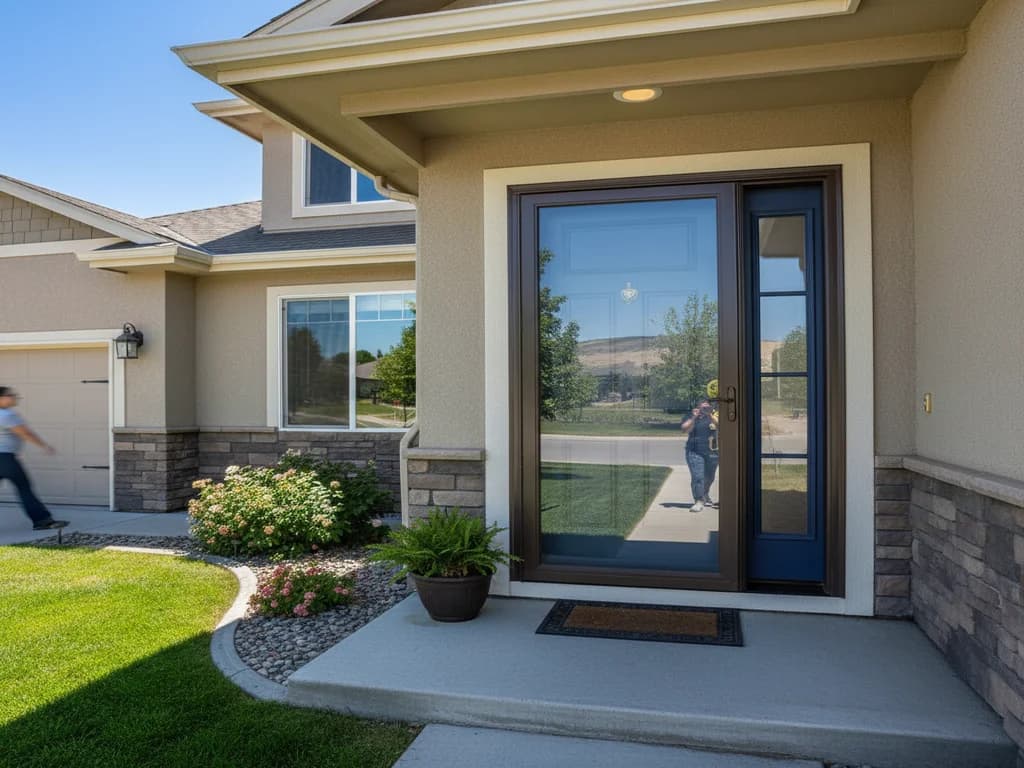
Mountain Home sits on the open high-desert plain along I-84, an Elmore County town near the Air Force base and ringed by sagebrush flats. Its climate is unusually hard on entries: near-constant summer sun, dry scouring winds, and cold winters that fade a finish and drive drafts through anything not sealed tight. A storm door is built for exactly that — it takes the UV and wind-driven grit so the main door doesn't, and traps a buffer of dead air through long cold spells. Iron Crest Exteriors installs full-view and ventilating models with interchangeable glass and screen, fastened with a closer and wind chain detailed for the steady wind. On a Mountain Home entry that's weathered the plain for years, the added layer makes a real difference.
What's included
- Full-view & ventilating models
- Interchangeable glass & screen
- Protects the entry door
- Added energy buffer
- Secure latching
From downtown Mountain Home to the Air Force base area and throughout Elmore County, our storm doors work in Mountain Home is matched to each home's age, style, and exposure.
Our process
How storm doors works in Mountain Home
- 01
Measure & assess
We measure the entry opening and confirm the storm door model, glass-and-screen configuration, and swing before quoting.
- 02
Model selection
We lay out full-view versus ventilating models and interchangeable glass-and-screen options so the door suits how you use the entry.
- 03
Fit & mount
We fit the door to the opening and mount it square so it closes and latches cleanly without binding or gapping.
- 04
Closer & wind detailing
We set the closer and any wind chain so the door doesn't slam or get caught and damaged by Idaho wind gusts.
- 05
Weatherstrip, latch & seal
We fit the weatherstrip and sweep and set a secure latch so the door seals against the buffer it's meant to create.
- 06
Walkthrough
We test the close, latch, and panel swap, clean up, and walk the operation with you.
Every Mountain Home job includes pulling any permit Elmore County requires and a full clean-up — we leave your home tight, weather-sealed, and looking sharp.
Working in Mountain Home
Mountain Home, high-desert Air Force town on the Snake River Plain
Mountain Home is an Elmore County town on the open high-desert plain along I-84, anchored by the nearby Air Force base and surrounded by sagebrush flats. The housing stock includes a large block of base-era and military-adjacent construction alongside older downtown homes, much of it carrying dated exteriors that have weathered the relentless high-desert sun and wind.
Mountain Home's high-desert climate — intense, near-constant summer sun, dry scouring winds, and cold winters — is unusually hard on exterior materials. Siding fades, chalks, and cracks faster here than in shaded urban settings, windows with worn weatherstripping bleed heat through long cold spells, and the steady wind makes properly fastened, tightly sealed siding and well-installed windows especially important.
Areas we serve
- downtown Mountain Home
- the I-84 corridor
- the Air Force base area
- rural Elmore County acreage
Around Mountain Home
- Mountain Home Air Force Base
- Bruneau Dunes State Park
- the Snake River Plain
- the I-84 corridor
Storm Doors in Mountain Home — FAQs
Will a storm door survive Mountain Home's constant high-desert wind?
It will when it's installed for these conditions, and on the Mountain Home plain we treat the wind as the main design factor. A storm door left unsecured can get caught and flung by a gust off the flats, so we set a heavy-duty closer and a wind chain or stop that limits the swing and absorbs the shock. Properly detailed, it stands up to the steady wind here and actually shields your entry door from the scouring grit the wind carries.
Is storm doors available across Mountain Home?
It is — every neighborhood in Mountain Home and the surrounding Elmore County, including downtown Mountain Home, the I-84 corridor, and the Air Force base area. Ask us for a free on-site estimate.
Is Mountain Home the only area you cover?
No — Mountain Home is one of many. We also serve Kuna, Boise, Meridian and the broader Treasure Valley, including homes around Mountain Home Air Force Base.
Will you clean up after storm doors in Mountain Home?
Always. Every Mountain Home job ends with a full clean-up — we haul away the old materials and packaging and leave your Elmore County home tidy and protected.
Does a storm door actually save energy?
It creates a buffer of trapped air in front of your entry door that reduces drafts and modestly improves the entry's energy performance, and it shields the main door from weather. It's not a substitute for a well-sealed entry door, but as an added layer it helps, especially on an exposed entry.
What's the difference between full-view and ventilating models?
A full-view storm door is mostly glass and shows off the entry door behind it; a ventilating model has built-in screen and operable glass sections for airflow. Many doors let you swap a full glass panel for a screen seasonally, giving you both. We'll match the model to how you use the entry.
Related doors options in Mountain Home
Exterior projects often pair up — here's what goes well with storm doors.
Helpful guides
Plain, local guidance to help you plan your storm doors project.
Need storm doors in Mountain Home?
Tell us about your Mountain Home home and the project you have in mind — we'll come look and give you a straight, free estimate.