Elmore County, Idaho
Siding Installation & Replacement in Mountain Home, ID
Mountain Home, high-desert Air Force town on the Snake River Plain
Mountain Home sits on the open high-desert plain along I-84, an Elmore County town anchored by the nearby Air Force base and ringed by sagebrush flats. Its climate is unusually hard on exteriors: intense, near-constant summer sun, dry scouring winds, and cold winters that fade, chalk, and crack siding faster than in shaded urban settings. The large block of base-era and military-adjacent construction, plus older downtown homes, often wears exteriors that have weathered exactly that. Iron Crest Exteriors re-sides these homes in fiber cement, engineered wood, or vinyl, tightly fastened to manufacturer spec with the lapped weather barrier and flashing the steady wind makes essential — because out here the install carries as much of the load as the material.
What's included
- Full siding replacement & re-side
- Fiber cement (James Hardie-style) lap & panel siding
- Engineered wood siding
- Vinyl siding
- Trim, fascia & soffit
- Moisture barrier & flashing detailing
From downtown Mountain Home to the Air Force base area and throughout Elmore County, our siding installation & replacement work in Mountain Home is matched to each home's age, style, and exposure.
Our process
How siding installation & replacement works in Mountain Home
- 01
Free on-site consultation and assessment
We walk the home, look at the existing siding and trim, probe for soft sheathing and moisture intrusion, and check how the current flashing and house wrap were detailed. You get a written estimate scoped to what the home actually needs — no charge, no pressure.
- 02
Material and color selection
We lay out fiber cement, engineered wood, and vinyl side by side with honest pros and cons for your home's architecture, exposure, and budget, then help you settle on profile, texture, and color so you can picture the finished result before anything is ordered.
- 03
Tear-off and substrate inspection
The old siding and trim come off down to the sheathing. We inspect the framing and sheathing, repair or replace any rot or water damage we find, and document anything that affects the scope before we cover it back up.
- 04
Weather barrier and flashing
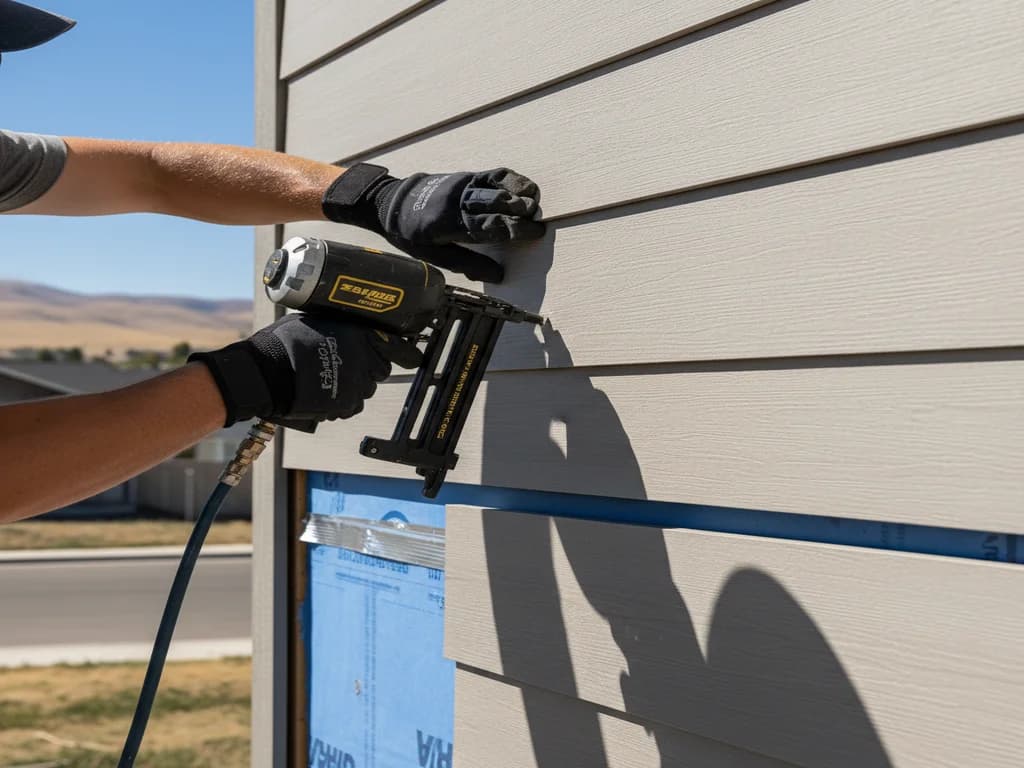
A continuous weather-resistive barrier (house wrap) is installed and properly lapped, then flashing is integrated at windows, doors, penetrations, and transitions so water is directed back to the surface instead of into the wall.
- 05
Siding installation to manufacturer spec
Siding goes on to the manufacturer's published specifications — correct fastener type and placement, proper overlap and clearances, and the right expansion gaps for the material — which is also what keeps the product warranty intact.
- 06
Trim, detailing, cleanup, and walkthrough
Fascia, soffit, corners, and trim are finished to match, joints are sealed where the system calls for it, and the site is cleaned with a magnetic sweep for stray fasteners. We walk the finished job with you before we call it done.
Every Mountain Home job includes pulling any permit Elmore County requires and a full clean-up — we leave your home tight, weather-sealed, and looking sharp.
Working in Mountain Home
Mountain Home, high-desert Air Force town on the Snake River Plain
Mountain Home is an Elmore County town on the open high-desert plain along I-84, anchored by the nearby Air Force base and surrounded by sagebrush flats. The housing stock includes a large block of base-era and military-adjacent construction alongside older downtown homes, much of it carrying dated exteriors that have weathered the relentless high-desert sun and wind.
Mountain Home's high-desert climate — intense, near-constant summer sun, dry scouring winds, and cold winters — is unusually hard on exterior materials. Siding fades, chalks, and cracks faster here than in shaded urban settings, windows with worn weatherstripping bleed heat through long cold spells, and the steady wind makes properly fastened, tightly sealed siding and well-installed windows especially important.
Areas we serve
- downtown Mountain Home
- the I-84 corridor
- the Air Force base area
- rural Elmore County acreage
Around Mountain Home
- Mountain Home Air Force Base
- Bruneau Dunes State Park
- the Snake River Plain
- the I-84 corridor
Siding Installation & Replacement in Mountain Home — FAQs
What siding holds up to Mountain Home's relentless high-desert sun and wind?
Fiber cement is about as well suited to it as siding gets — its dense mineral makeup resists the fade, chalking, and cracking that the near-constant UV and dry, scouring wind drive into vinyl and old hardboard, and pre-finished color holds especially well on the sun-beaten walls. Modern color-through vinyl is far more fade-stable than the original material and keeps costs down; engineered wood sits between. The other half is the install: in this kind of sustained wind, correct fastening, clearances, and a continuous flashed barrier are what keep any wall tight, so we install to spec.
Which parts of Mountain Home do you serve?
All of them — from downtown Mountain Home to the Air Force base area and throughout Elmore County. We'll come to your Mountain Home home for a free estimate.
Can you help with siding installation & replacement in towns near Mountain Home?
Absolutely. Beyond Mountain Home, we cover Kuna, Boise, Meridian and the rest of the Treasure Valley — anywhere out toward Mountain Home Air Force Base is comfortably within our range.
Will you clean up after siding installation & replacement in Mountain Home?
Always. Every Mountain Home job ends with a full clean-up — we haul away the old materials and packaging and leave your Elmore County home tidy and protected.
What siding material is best for Idaho homes?
There's no single best answer — it depends on your priorities. Fiber cement is the most durable option for our climate, resisting UV fade, moisture, and insects with low maintenance, but it's heavier and costs more to install. Engineered wood gives a warmer, natural grain at a lighter weight and better moisture tolerance than solid wood, with periodic repainting down the road. Quality vinyl is the most affordable and, installed with correct expansion allowance, holds up well. We'll match the recommendation to your home's exposure, your maintenance appetite, and how long you plan to stay.
Should I repair my siding or replace all of it?
Targeted repair makes sense when damage is confined to a few boards and the surrounding siding, flashing, and weather barrier are sound. Once you're seeing widespread cracking, fading, warping, or signs that moisture has gotten behind the cladding, a full re-side is usually the better long-term value because patching can't fix a failed barrier or flashing underneath. We'll tell you straight which situation you're in after we've actually looked at the wall.
Siding Installation & Replacement in nearby cities
We work across the Treasure Valley near Mountain Home.
Related services in Mountain Home
Exterior projects often pair up — here's what goes well with siding installation & replacement.
Helpful guides
Plain, local guidance to help you plan your siding installation & replacement project.
Need siding installation & replacement in Mountain Home?
Tell us about your Mountain Home home and the project you have in mind — we'll come look and give you a straight, free estimate.